



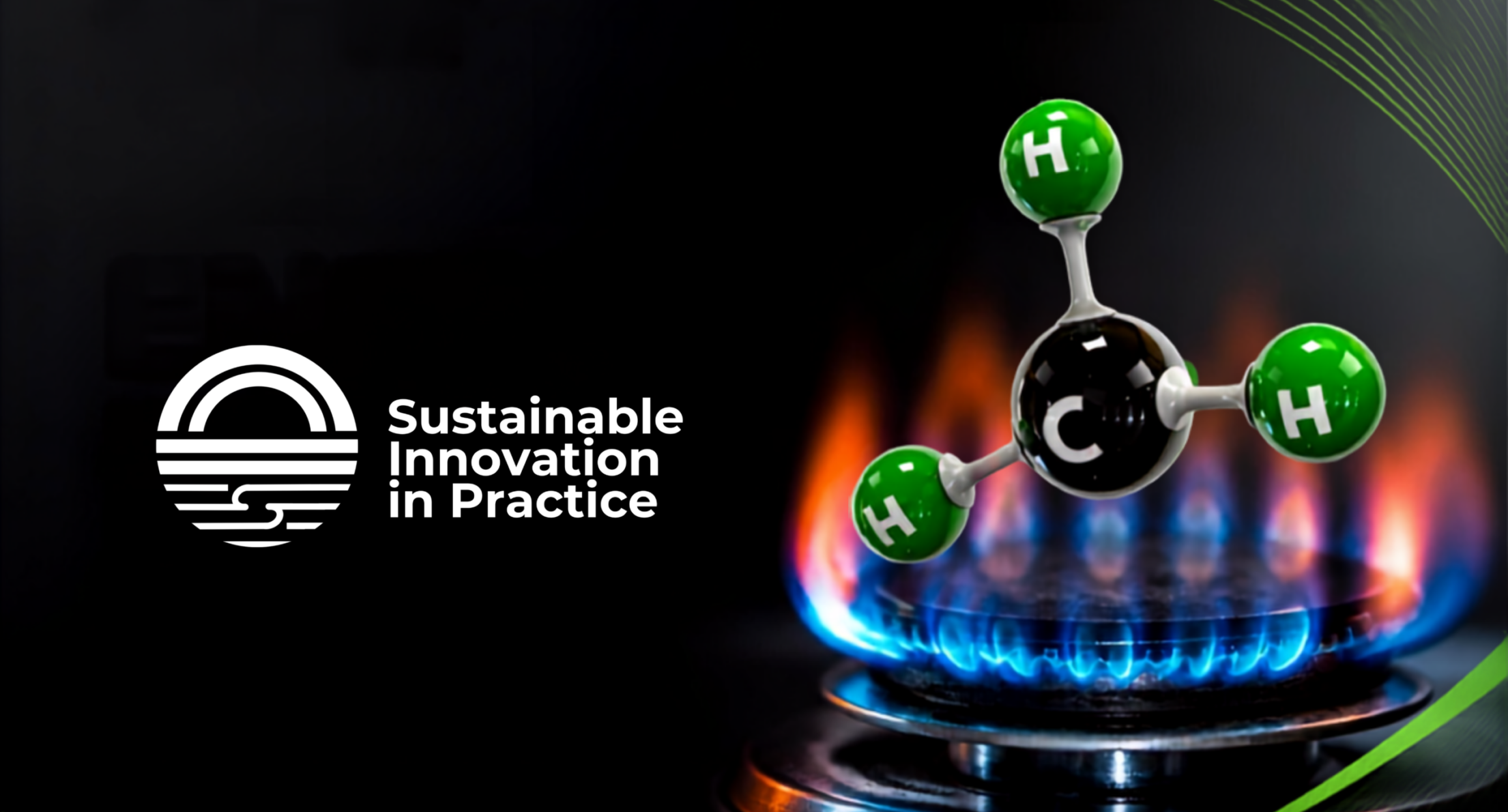
Managing Methane Emissions: A Critical Step Toward Credible Climate Action
Sustainable Innovation in Practice (SIP)
Methane (CH4) is one of the most potent greenhouse gases and a critical target in efforts to mitigate climate change. Despite its much shorter lifetime in the atmosphere (ca. 12 years) than carbon dioxide (CO2) (hundreds to thousands of years), methane has a significantly greater warming potential (i.e., 29.8 and 27.0 kg CO2e/kg of fossil and biogenic methane, respectively) [1], making it responsible for a substantial share of near-term global warming. As governments and businesses strive to upgrade their decarbonization strategies, growing attention is being directed toward CH4 emissions from several important sectors, such as oil and gas, waste management, wastewater treatment, agriculture, and renewable energy systems. Therefore, it suffices to say that effective methane management represents one of the most promising yet often overlooked opportunities to achieve tangible climate benefits while supporting long-term net-zero ambitions.
Against that backdrop, the ASEAN-Republic of Korea Cooperation for Methane Mitigation (AKCMM) project was officially launched in Indonesia in May 2026 as a collaborative initiative between Indonesia, the Republic of Korea, ASEAN, and the Global Green Growth Institute (GGGI) to strengthen CH4 emission reduction efforts, particularly in the waste sector. Given that Indonesia is the third ASEAN country to implement such an important initiative after Malaysia and the Philippines, the country will utilize the three-year USD 20 million initiative to enhance CH4 monitoring systems, strengthen policy frameworks, develop financially viable mitigation projects, and promote regional cooperation [2]. The project is in accordance with Indonesia’s climate commitments and national development agenda, taking into account that organic waste accounts for approximately 63% of landfill waste and contributes significantly to CH4 emissions, making it a critical component of the nation’s broader climate action plan. It also seems more relevant as the Indonesian government has floated the idea of deploying CNG comprising CH4 to replace imported LPG for daily use. Additionally, CH4 regulation is also gaining greater international attention under the Renewable Energy Directive (RED II) and its successor, RED III, suggesting that renewable fuel and biogas producers must demonstrate substantial greenhouse gas emission savings throughout their value chains to qualify for sustainability certification and market access [3].
While CH4 emissions originate from a wide range of sectors, recent studies on wastewater and biogas systems provide an important illustration of how underestimated emissions can compromise climate outcomes [4]. Recent scientific studies published in Nature Sustainability have found that CH4 leakage and/or emissions from wastewater biogas recovery systems, which are intended to produce cleaner fuel, range from 0.4% to 65% of produced biogas, significantly exceeding the levels typically assumed during project evaluations [5]. Such findings imply that considerable amounts of CH4 emissions can negate, or even partially reverse, the intended climate benefits of renewable energy or environmental projects t
hat are otherwise designed to reduce greenhouse gas emissions. Likewise, Song et al. (2024) emphasized that achieving net-zero emissions requires comprehensive CH4 accounting across all emission scopes [6].
Interestingly, recent research published in Nature gives a glimmer of hope, as it suggests that temporary carbon dioxide removal (CDR), such as nature-based solutions rather than technological carbon capture followed by permanent CO2 storage in depleted oil reservoirs, can play a pivotal role in offsetting the warming effects of short-lived climate pollutants such as CH4, unlike persistently long-lived CO2 [7]. For example, 1 kg CH4 could be compensated by ca. 101 kg stored for 100 years (or 498 kg CO2 stored for 20 years), whereas temporary CDR cannot fully offset CO2 because its warming effect remains for centuries, while the cooling effect of temporary storage eventually diminishes. Thus, the study indicates that relatively affordable yet temporary interventions can provide corresponding climate benefits when appropriately matched to CH4 emissions. This finding is particularly relevant for Indonesia, where CH4 mitigation initiatives have started to emerge in sectors such as palm oil through biogas recovery from Palm Oil Mill Effluent (POME), reflecting growing recognition of methane management as part of the national decarbonization strategy [8,9]. However, the study emphasizes that temporary carbon removal should not be viewed as a substitute for CH4 mitigation. Instead, it should serve as a complementary strategy, particularly in sectors where methane emissions are difficult to eliminate completely.
Taken together, these scientific and regulatory developments underscore the growing importance of accurately quantifying and verifying CH4 emissions and mitigation outcomes. As scientific evidence continues to reveal loopholes and discrepancies between assumed and actual CH4 emissions, organizations are under immense pressure to accurately quantify, monitor, and verify emissions. Robust measurement and verification systems are therefore essential to ensure that reported climate benefits are real, transparent, and in line with regulatory requirements and stakeholder expectations. According to these climate goals and scientific evidence, Sustainable Innovation in Practice (SIP) is an independent third-party validation, verification, and certification body (VVB) that conducts assessments of sustainability and climate-related claims, including credible net-zero pathways, for credibility, accuracy, and transparency.
References
[1] Intergovernmental Panel on Climate Change (IPCC), Climate Change 2022: Mitigation of Climate Change. Contribution of Working Group III to the Sixth Assessment Report of the Intergovernmental Panel on Climate Change, 2022.
[2] Perkuat Aksi Iklim, Proyek Metana ASEAN-Republik Korea Resmi Memulai Langkah di Indonesia. May 21, 2026. https://kemenlh.go.id/news/detail/perkuat-aksi-iklim-proyek-metana-asean-republik-korea-resmi-memulai-langkah-di-indonesia
[3] O. Hurtig et al., Mitigating biomethane losses in European biogas plants: A techno-economic assessment. Renew. Sustain. Energy Rev. 2025, 210, 115187. https://doi.org/10.1016/j.rser.2024.115187
[4] S. Bakkaloglu et al., Methane emissions along biomethane and biogas supply chains are underestimated. One Earth 2022, 5, 724-736. https://doi.org/10.1016/j.oneear.2022.05.012
[5] X. Li et al., Methane leakage thresholds for net climate benefits of wastewater biogas recovery. Nat. Sustain. 2026. https://doi.org/10.1038/s41893-026-01818-7
[6] C. Song et al., Defining and achieving net-zero emissions in the wastewater sector. Nat. Water 2024, 2, 927-935. https://doi.org/10.1038/s44221-024-00318-2
[7] Y. He et al., Temporary carbon dioxide removal to offset short-lived climate forcers. Nature 2026. https://doi.org/10.1038/s41586-026-10607-3
[8] Manfaatkan POME, Pertamina Gandeng PTPN III Turunkan Emisi Karbon 70 Ribu Ton per Tahun. Aug 23, 2021. https://www.minergy-news.com/manfaatkan-pome-pertamina-gandeng-ptpn-iii-turunkan-emisi-karbon-70-ribu-ton-per-tahun/
[9]Laporan Capaian Aksi Mitigasi (LCAM), Pembangkit Listrik Tenaga Biogas Sukadamai 2,4 MW dari Recovery Biogas pada Pengolahan Limbah POME. https://asset.srnmenlh.id/srn-menlhk/programs/22371d55-8c88-4833-96ba-785e506bd520/lcam/2023/a9d2d0d8-cfb7-4239-9321-852e791c458c.pdf